As we’re learning more about the history of photography, there may be somethings that you hear in class that spark your interest. Unfortunately, we can’t use hot mercury vapors in the darkroom to make daguerreotypes, nor can we make many of the processes we’ll be learning about in class. However, in the case that any of you were interested in learning more about photography’s past, here is a goo resource on the evolution of the process as well as some cool videos/links.
This page will be updated throughout the semester
– Ancient times: Camera obscuras (Latin: “darkened room”) is considered to be the earliest camera. A tiny hole in a darkened box allowed an image to be projected upside-down and backwards on the opposite wall.
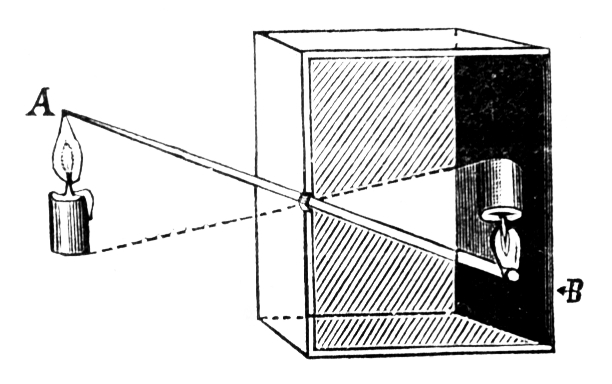
– 16th Century: telescopic lenses were attached to camera obscuras to improve brightness and clarity. Adding a mirror within the box reflected the image onto a ground glass created a much more portable camera obscure, allowing artists to have more variety in the compositions.

– 1816: Nicephore Niepce makes a photographic print in a camera obscura, but cannot stop the image from continuing to darken once exposed to more light.
– 1826: Niepce creates the first fixed image using asphalt on metal and calls it heliography meaning “sun drawing.”
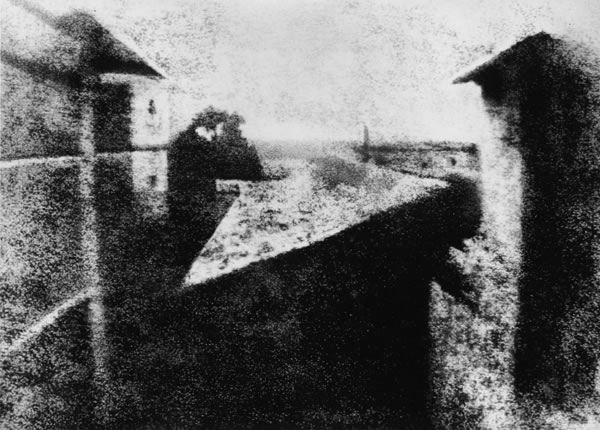
View from the Window of Le Gras, Niepce, 1826
– 1834: William Henry Fox Talbot creates permanent paper negatives and uses them to print paper positives. He calls this process the Calotype or Talbotype. He doesn’t patent this process for several years, while other innovators of photography continued to make advancements.
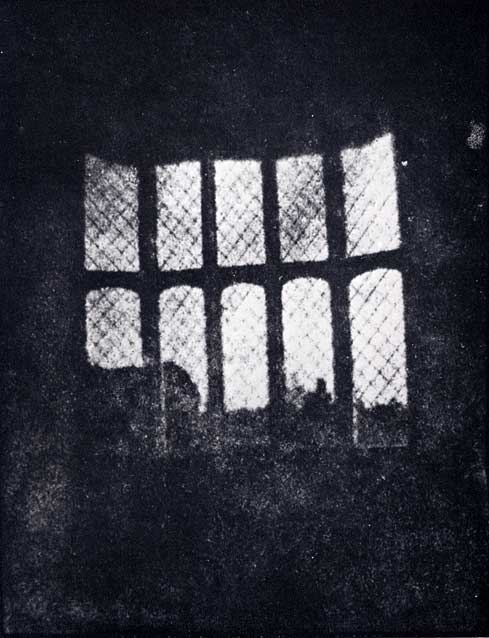
Latticed Window at Lacock Abbey, William Henry Fox Talbot
– 1837: Louis Daguerre creates daguerreotypes on silver-plated coper and processing it with hot mercury vapors.

– 1839: Daguerre presents and explains the daguerreotype process at the French Academy of Sciences and receives credit for making the photographic process practical and accessible
– 1841: Talbot patents his Calotype/Talbotype process. He sells licenses to photographers who want to use his process as a way of compensation after spending thousands of dollars of his own money inventing the process.
– 1842: Cyanotypes invented by Sir John Herschel, however it is Anna Atkins who first uses this process in a photographic way, making photograms of plants. She becomes one of the first female photographers.

Algae, Anna Atkins
– 1851: Frederick Scott Archer creates the Wet Plate Collodion process, improving the quality of the photographic negative by shooting an image on glass. Wet Plate Collodion could also be viewed as a positive when placed on a black background.
– 1850s: Albumen prints were invented by Louis Désiré Blanquart-Evrard. Using egg whites and silver nitrate on paper, this process made photography cheaper and more accessible to the public and was the most popular form of photographic printing between the 1860s-1890s.
– 1854: Andre Disderdi invents carte de visites, small photographic images printed on cards, enabling the mass production of photographs and sparking a boom in portrait studios around the world.
Carte de visite toreros, El regatero, Gayetano et Ossuna, by Disderi, 1860
– 1855: Stereoscopic photography become a popular use of photography and was often used in schools to teach geography and world history – suddenly students in small towns/cities were able to see images of places all over the world without leaving their classroom. Formed by 2 images side-by-side, when viewed through a set of lenses, a stereogram would look like a 3-D image.

stereoscopic viewer