
National Chemistry Week
Reply

E komo mai!
For the 2017 – 2018 school year the kumus are:
Kinder – Grade 2: Bev Kutsunai /[email protected]
Grade 3 – Grade 4: Debbie Uwaine/[email protected]
Grade 5 – Grade 6: Joan Rohloff/[email protected]
One essential question we will be examining throughout the year is “What does it mean to be a Hawaiian scientist?”
Please share your mana‘o! We look forward to our journey in science education!
Grade 3 – 6 scientists were fortunate to have a visiting scientist and KS alumni, Dr. Kalama Hiheu, share her experiences from the Dakota Access Pipeline. She connected the science issues of how oil use affects global warming. She also shared the pride she felt to help the Standing Rock Sioux Tribe protest peacefully as water protectors.


Students were able to ask questions about the protest and about how to take care of water.

How do you care for and keep your water clean in your ahupua‘a?
Kumu Kutsunai and Kumu Rohloff attended a meteorology workshop at ‘Iolani School.

The title of the workshop was “Meteorology in the Modern Age: Clouds and Climate Change.” The guest expert, Jennifer Griswold from UH, shared her work from all over the globe in cloud microphysics and climate change. Kumus from around the island investigated weather phenomena, cloud formation and El Nino and La Nina.
Here are some resources to research climate change on your own! 



One Learns By Doing
This posted project spanned a year of professional development by Bev Kutsunai, Science Specialist and Donna Rosehill, Educational Assistant in Kindergarten. It represents our learning about how we can draw viewers into our students experience while they are exploring their learning process in kindergarten science. It shares student thinking in pictures, writing and their own words. The documentation panel provides evidence of their work in progress. It is a snapshot of a lesson in our unit investigating trees. This process is an integral part of our science program in Grades Kindergarten through Grade 3. We are pleased how it recognizes each of our students as a capable, active learner.
Educators are transformed when we listen to children—valuing their voice, thinking along with them, and honoring their capabilities.





What children learn does not follow as an automatic result from what is taught, rather, it is in large part due to the children’s own doing, as a consequence of their activities and our resources.
-Loris Malaguzzi, The Hundred Languages of Children
This process is based upon the work of educators in the Reggio Emilia schools for young children in Italy. Mid Pacific Institute Elementary and Preschool have been involved in successfully adapting this approach for their young learners.
Educators on O’ahu have come together to learn more about this approach during the past few years. Professional development activities have included teacher workshops, conferences and meetings and a visiting exposition at Leeward Community College entitled The Wonders of Learning with examples of student discoveries from the school of Reggio Emilia. Bev Kutsunai was delighted to be a member of team of early educators from Kamehameha Elementary that attended an international workshop and visited school in Reggio Emilia, Italy.
Aloha Mai Käkou!
Welcome to our science blog! Activities, investigations, questions and ideas will be posted here. Please leave your comments and ideas!

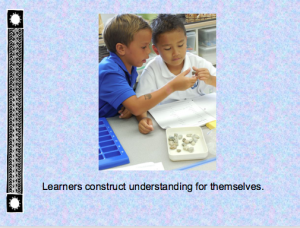
Haumäna share discoveries from an owl pellet with Kumu Rohloff
I am Joan Rohloff and I am thrilled to be a science Kumu (Grades 5 – 6) at Kamehameha Elementary School. I am new to island life and call Alaska my home. In the summer months I fish for salmon and enjoy the subsistence lifestyle in the southeast Alaskan coastal village of Yakutat.

Second grade students learn about air resistance by making parachutes in teacher Bev Kutsunai’s science class.

Mrs. Kutsunai
Mrs. Kutsunai (Grades K – 3) and Mrs. Uwaine (Grades 4 – 5) will also share student experiences on this page so please check in!
http://blogs.ksbe.edu/kesscience/

Mahalo Nui Loa,
Joan Rohloff
Beverly Kutsunai
Debbie Uwaine
“Haumäna will become local and global servant leaders who are culturally engaged and play significant roles in creating strong ‘ohana and communities throughout ka pae ‘aina o Hawaii‘i and beyond.” The roots for this outcome are nourished in the KES science community through the inquiry process and place-based learning.