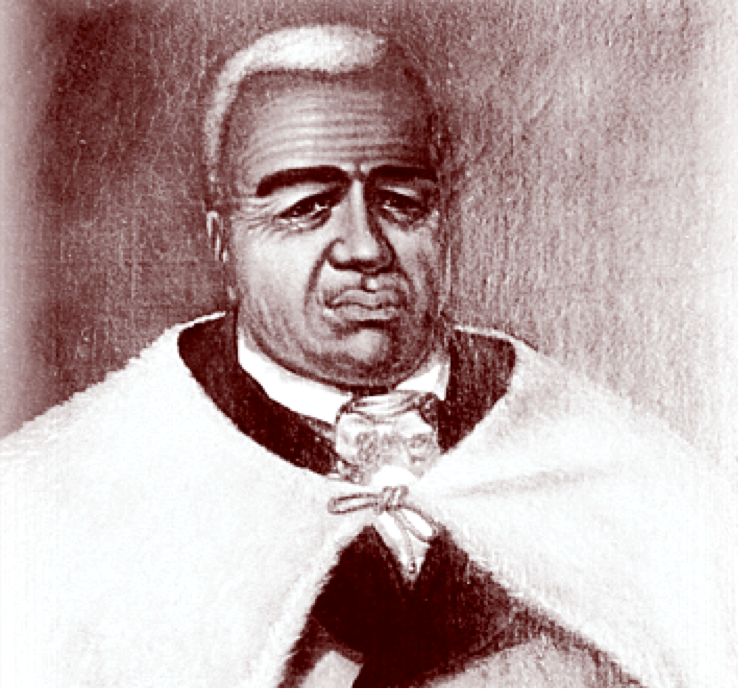
Kamehameha was one of the greatest Hawaiian chiefs. Historians often credit Kamehameha with being the first to unite the eight major Hawaiian Islands under one rule, establishing a peaceful kingdom. Before that, different ali`i (chiefs) ruled the separate islands. By 1795 Kamehameha conquered six of the islands. Eventually Kaua`i and Ni`ihau became part of the new kingdom.
Kamehameha was born at Kapa`akai, Kokoiki, Kohala, on the island of Hawai`i. The exact date of his birth is not known but is thought to be November 1758 because of two natural events. First, Kamehameha was born during a time of rain, thunder, lightning, strong winds, and high seas. And November was the month for such stormy weather. Second, a very bright star appeared in the sky. The star may have been Haley’s Comet, which was seen by astronomers in 1758.
Kamehameha’s parents, Keoua and Keku`iapoiwa, were both ali`i. Kamehameha was called Pai`ea until about the age of five, when he was given the name Kamehameha. From early childhood Kamehameha was trained to be a leader. He learned the customs, traditions and the genealogical chants that traced his ancestry to the gods. He played games and sports that strengthened his muscles and developed his skills and endurance. The great koa (warrior) Kekuhaupi`o taught him the art and rules of warfare, the code of good sportsmanship and the performance of his religious duties and ceremonies. Kamehameha excelled in every way and became a great leader.
Kamehameha was a wise and just ruler. He maintained the kapu system (traditional system of laws) and chose a governor for each island. He made laws to protect both ali`i and maka`ainana (people that tend the land). His famous Malama Hoe (Law of the Splintered Paddle) protected the weak from the strong.
Everyone had to work, and Kamehameha himself worked hard with his own hands. For example, in addition to his administrative duties, he sometimes worked in the lo`i kalo (taro patch). He encouraged the training of new kahuna (experts) in order to perpetuate the various skills needed in Hawaiian society. Kamehameha was friendly to people of all nations, and as a result trading with foreigners grew. But he kept the ways of his culture and added what he considered the best of the new.
Kamehameha`s last words were “E `oni wale no `oukou I ku`u pono–” (“Carry on my good work–“), at this point he expired, his sentence unfinished. He died in 1819 at Kamakahonu, Lanihau, Kona, on the island of Hawai`i. As was custom of the time, his bones were secretly hidden.
Source: NA LANI KAMEHAMEHA by Ke`ala Kwan, Jr. and Francis K.W. Ching, Hawaiian Studies Institute, Kamehameha Schools Bishop Estate, 1989