School Description
Keonepoko Elementary School (KEO) is a Department of Education (DOE) PreK-6 school located in the eastern part of Hawai’i Island, in the district of Puna. Keonepoko Elementary School is about 20.2 miles from Hilo international airport. Keonepoko Elementary School services a multicultural population with the population of either Hawaiian/Part-Hawaiian ancestry at around fifty-three percent. The majority of student, 92%, qualify for free or reducted-cost lunch. Keonepoko is tucked within the ʻōhiʻa trees of Puna district. Early Hawaiians identified many of Puna’s treasures within moʻolelo and ‘ōlelo noʻeau. One example of this is the saying “Ka ua moaniani lehua o Puna”; the rain that brings the fragrance of the lehua of Puna. Through these words, we understand the value of our surrounding forest and rains that perpetuate the diverse life cycles our forests support. It is also in these forests where the first hula is said to have been danced by Pele’s sister, Poliʻahu. The school’s physical location also has significant historical value. A major battle once took place where H building and the library stands. Additionally, the school has named their mascot as Nā Pueo “The Owls” due to their abundance in the area. Keonepoko is a school located in a rainforest environment that recently has been affected by Hurricane Iselle, Tropical Storm Ana and currently threated by an active lava flow. The threat of this flow has caused the closing of Keonepoko Elementary and has been relocated to a temporary location in the parking lot at Keaʻau High School and is now known as Keonepoko North.
School Vision
We are all responsible for making Keonepoko a positive, respectful, safe place where we learn to think and learn to learn in order to be a valued contributor in any community with aloha and integrity.
School Mission
Keonepoko Elementary Schools mission is for each child to achieve high academic and personal standards in a safe environment to successfully meet the challenges of life.
Community Demographics
According to data taken in the 2014-15 school year, the two largest ethnic groups identified at Keonepoko Elementary are: Hawaiian/Part Hawaiian and White.
Click on the images below to enlarge graphics.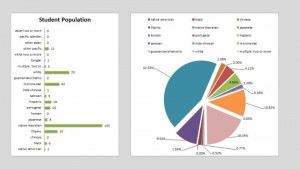
Teachers
By clicking on the this link “Certified_Staff” the data presented will outline the certified staff at Keonepoko Elementary for the 2014-15 school year.
Administration
Dr. Brandon Gallagher had been the school’s principal through the turbulent 2014-15 school year and has since returned to California to be with his ‘ohana. The current interim school principal is Kasey Eisnehour. Returning to Keonepoko for her second year is Vice-principal, Darlette Driskell. In addition, Keonepoko Elementary School has two counselors, one librarian and on staff Student Activity Coordinators, Student Services Coordinators, Registrars, Athletic Directors, and Resource Teachers.
Community
Keonepoko Elementary School is one of two elementary schools located in the Pāhoa area of Puna. The school services five subdivisions within Puna; Hawaiian Beaches, Hawaiian Shores, ‘Āinaloa, Orchid land, and parts of Hawaiian Paradise Park.
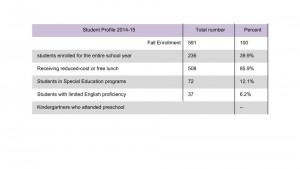
In the 2014-15 school year, 85.9% of the student population received free/reduced lunch. According to the 2010 U.S. Census, the American Community Survey (ACS) 2006-2010, and the incorporation of Hawaiʻi’s HSC boundary areas the following graphic provided below displays data for the Pāhoa High School Complex (HSC).
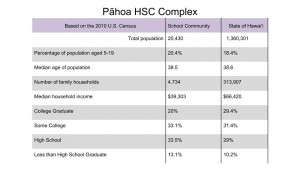
The number of students receiving this service has been steadily increasing since 2009. Therefore, the majority of the Pāhoa student population comes from impoverished families. Transiency and attendance are issues that challenge the school throughout the course of the school year. It is not uncommon to go into a class one day and be introduced to a new student and within a short time that two other students have left. People move into the community because of low land prices and the opportunity to live in an affordable home. Families also take in many other family members when times get tough and jobs are scarce. Leaving the community is often due to better job/career choices or the need to move in with family members who live somewhere else.
Kealapono Contributions
Kealapono has been partnering with Keonepoko Elementary School for several years. The mission of our division is “to create opportunities for Native Hawaiian keiki and ‘ohana to foster the love of learning and enable them to build foundations that embody cultural identity and acedemic preparedness for continued growth.” Our current regional focus on Hawaiʻi island is to improve the literacy skills of students in grades K-3, through the context of science. Achieving this goal is done by utilizing culturally relevant practices (mele, oli, moʻolelo), place based as well as culture-based learning to expand their understanding of the place in which they live. Our lessons are aligned with the Common Core State Standards (CCSS), the state science benchmarks/standards, and the Literacy Thinking Skills, by Fountas and Pinnell. Although HCPS III is the standard haumāna are tested in, we are in the process of aligning our science units to the Next Generation Science Standards.
Knowledge Gained
Based on the data collected, it is clear to me that there is a definite need to better the situation in the Pāhoa/Puna district to ensure a better future for its current residence and our haumāna who will become adults, community members and future leaders for that place they call home. Having a connection and sense of place will prepare our haumāna to be successful in securing a better future for themselves, their ‘ohana, and community. With continued support for the kumu and administration these positive changes can and will be possible in Pāhoa/Puna. With the information attained, along with my prior ‘ike, skills and strategies gained from our regional and divisional meetings, PDs and other opportunities to grow myself professionally as well as personally in order to become an excellent kumu and reliable resource for Kelapono, our DOE partners and community.